Deep Roots in Our Land
By Met Rogers
There is a difference between knowing history from a textbook and feeling it under your boots. I was born up the road in Anderson, South Carolina, and lived briefly in Matthews, North Carolina, before my parents landed in Aiken County. That’s where I grew up, right in the heart of what’s known as "The Valley." My childhood was spent riding bikes from one end of Highway 421 to the other, VRA sports, and finishing by public schooling as a graduate from Midland Valley High School.
But the road that truly connects my past to my present is Highway 28. I’ve ridden up and down 28 my entire life. It’s where I learned to drive more than a few miles from home, and hit my first deer, making the regular trips from our home up to visit my grandparents in Fair Play, Walhalla, and Anderson. Decades before I understood the full scope of my family’s history in these counties, I was already learning the curves of the road that tied them all together.
The Valley shaped my early years, and it’s also where I met my wife, Erika. We actually grew up together, though the stars didn’t align for us to become a couple until we were 29 years old. Once we partnered up, we shared a specific, long-term vision. We spent years focusing on buying, remodeling, and flipping or renting homes. It wasn’t just a business for us; it was a deliberate, hands-on path we carved out so we could eventually acquire raw land and, one day, build a farm of our own.
My family research is still very much a work in progress, genealogy has a habit of revealing two new questions for every answer you find—but the deeper I dig into this region, the more I realize how tightly bound my ancestors are to this specific corner of South Carolina.
Long before I started looking at old land records, my Granny and Papa instilled in our whole family to look forward to the annual Parks Family Reunion. Every year, we would plan the entire weekend around it, packing up tents and campers and heading down to the historic Price's Mill. The mill wasn't just a historic landmark to us; it was the backdrop of childhoods and reconnecting with distant family. I remember the grand spread of home cooking laid out across the long concrete table, and the excitement of catching my very first fish there on a small rod and reel. Because of how the calendar fell, my older brother Eddie and I even spent many of our birthdays celebrating right there at the reunion, surrounded by generations of family.
That deeper historical footprint always leads straight back to that very same stretch of highway, driving through Parksville. It isn't just a dot on a map along Route 28 or a quiet spot near the waters of Clarks Hill Lake. Established around 1826 and formally incorporated in 1882, it’s a place built on grit, faith, and a fierce sense of community. The people here have always been close-knit and fiercely loyal.
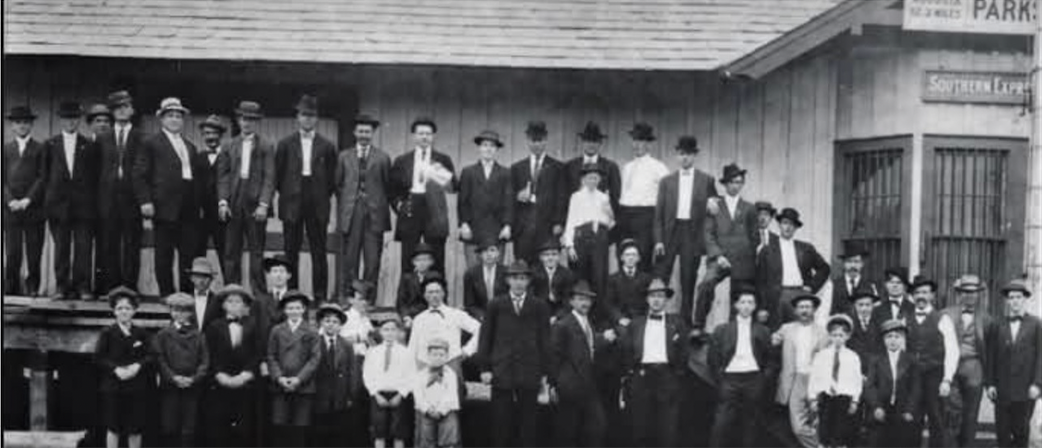
Parksville, SC
While the history of Parksville is vital to the area, my own heritage spans a wide network of families who shaped this entire region. My research continually leads me back to the deep roots of the Rogers name, alongside the Swilling, Tompkins, Parks, Gibson, Rowland, Creswell, and Wilson lines. These families didn't just inhabit one town; they settled the hardwood bottoms, operated the early grist mills, worked the timber, and built the homes that defined the frontier of the old Edgefield District. When I look at Price’s Mill today, I don't just see old timber, stone, and the spot where I caught my first fish. I see the blueprint of our local economy and the enduring partnerships that still connect us to our neighbors.
All those years Erika and I spent swinging hammers and remodeling houses were driven by a desire to get back to this land. When it finally came time to realize that dream, we chose to plant our roots just five minutes down the road from Parksville, right here in Plum Branch—right off the same Highway 28 I've traveled since childhood.
Anderson, Edgefield, Abbeville, Parksville and the mill represent a vital piece of our regional history, but Plum Branch is where we found the space to breathe, work, and build the farm we always wanted. On this property,surrounded by planted pine timberland, creek bottoms, and the same quiet woods my ancestors knew—we are raising our son and building something from the ground up. It’s a place where hands-on work still matters, whether it's clearing a garden site, tending to the animals, or restoring the land.
We aren't just living on historical laurels. The research into where we came from is important, but what we do with the land today is what matters. By honoring the generations of Rogers and connected families who came before us, we’re building a lasting legacy right here in the soil.
About the Author
Met Rogers is co-owner of The Heritage Farm at Stevens Creek and serves as a Vice President at FIS. A lifelong resident of the area with deep family roots throughout the region, he has a passion for local history, genealogy, and the land his ancestors called home. He often describes South Carolina as "God's Country" and believes there is something special worth preserving about the people, traditions, and landscapes that define it.
While his professional career keeps him busy, Met works remotely and can often be found stepping away from his desk to climb on a tractor, repair a fence, clear a trail, or tackle the next project on the farm. Much of his contribution happens behind the scenes through property improvements, maintenance, and land stewardship. His dedication to preserving the character of the land and improving the farm for future generations helps lay the foundation for everything The Heritage Farm is becoming.